
Sustainability governance
Firmly anchored sustainability governance
The very top management of our organization is committed to sustainability. Responsibilities are clearly defined at every level and closely linked to strategy. All sustainability-related activities are supervised by the Board of Directors. The Strategy and Sustainability Committee supports the CEO in developing corporate strategy and advises the Board of Directors on all matters relating to strategy and sustainability.
The risks and opportunities linked to sustainability are managed as part of the overall company risk management process and are reported to the Audit Committee and to the Board of Directors.
All members of the Executive Management are also members of the Executive Sustainability Team, which is responsible for the strategic approach at Group level and compliance with our sustainability roadmap.
Our sustainability governance
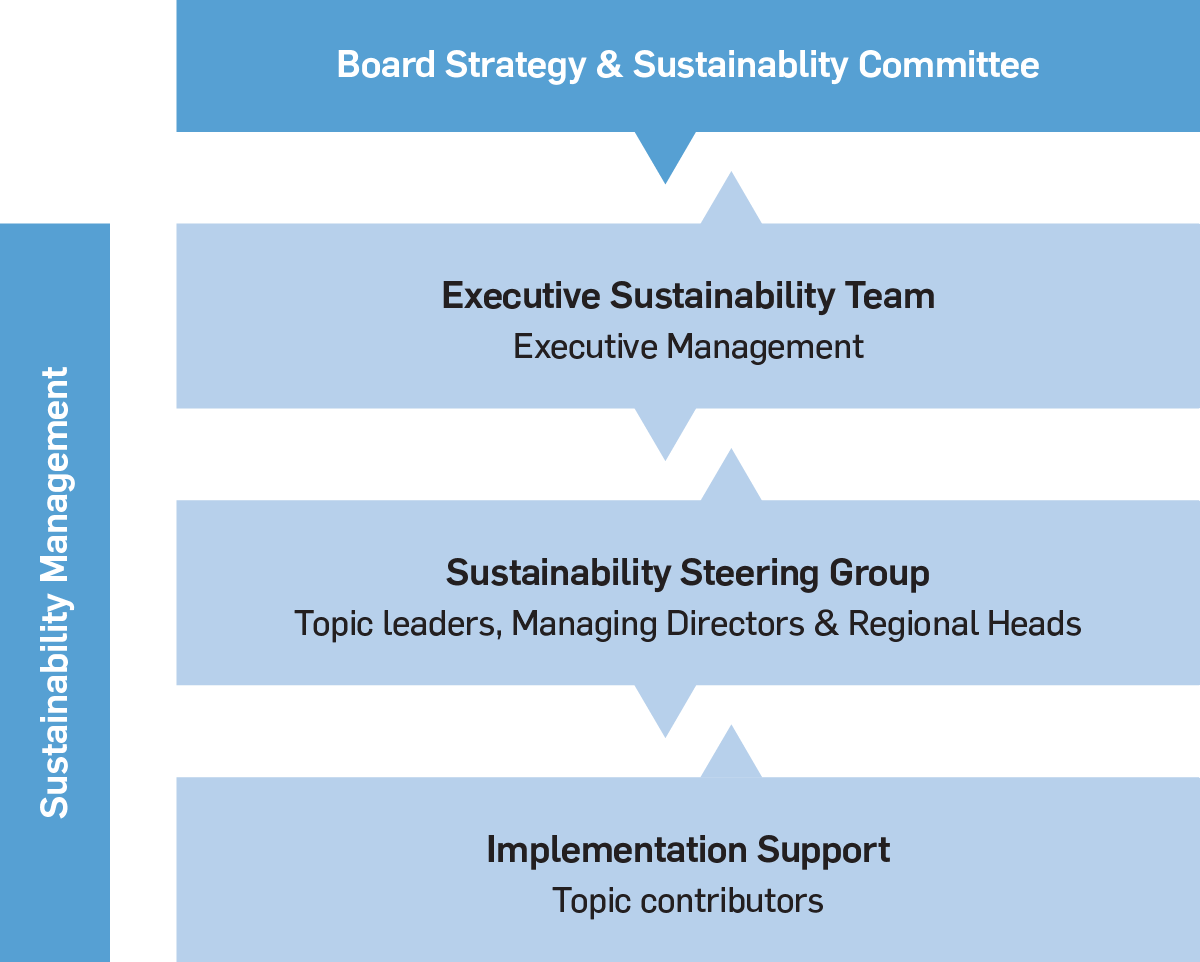
Every material topic is led by a member of senior management. These managers form the Sustainability Steering Group together with the Managing Directors of the production and assembly sites, and the Regional Heads from the Services Division. The Sustainability Steering Group is responsible for implementing the sustainability roadmap and defining the topic-specific management approach.
Implementation is supported by designated experts in the field and key local individuals in the subsidiaries. They provide technical expertise and ensure on-site implementation. A designated sustainability manager leads and moderates the related activities at Group level and, as a technical expert, supports all functions and subsidiaries with implementation of the roadmap.
A clear focus based on our materiality analysis
We use a materiality analysis to determine where our company’s activities have the greatest impact on society, the environment, and the economy. For this purpose, we conducted an impact analysis, where we assessed actual and potential positive and negative impacts of our activities along the value chain. In the fiscal year 2023, we further enhanced our analysis with the perspective of actual and potential implications for our business success, thereby considering a double materiality perspective. The aspects of scale, scope, and likelihood of impacts were considered as assessment categories with a precedence of scale and scope. Impact is the only determinant for materiality definition for the GRI reporting to be aligned with the standards.
For each of the eight material topics, we have appointed a topic leader as an advocate. Operational topics are important to us as well, but we do not pursue them with the same strategic approach as the material topics. They are integrated into the operational business activities at the departmental level. Other topics may be of greater relevance for a specific subsidiary, but not across the whole Group. We address these topics on a situation-specific basis.
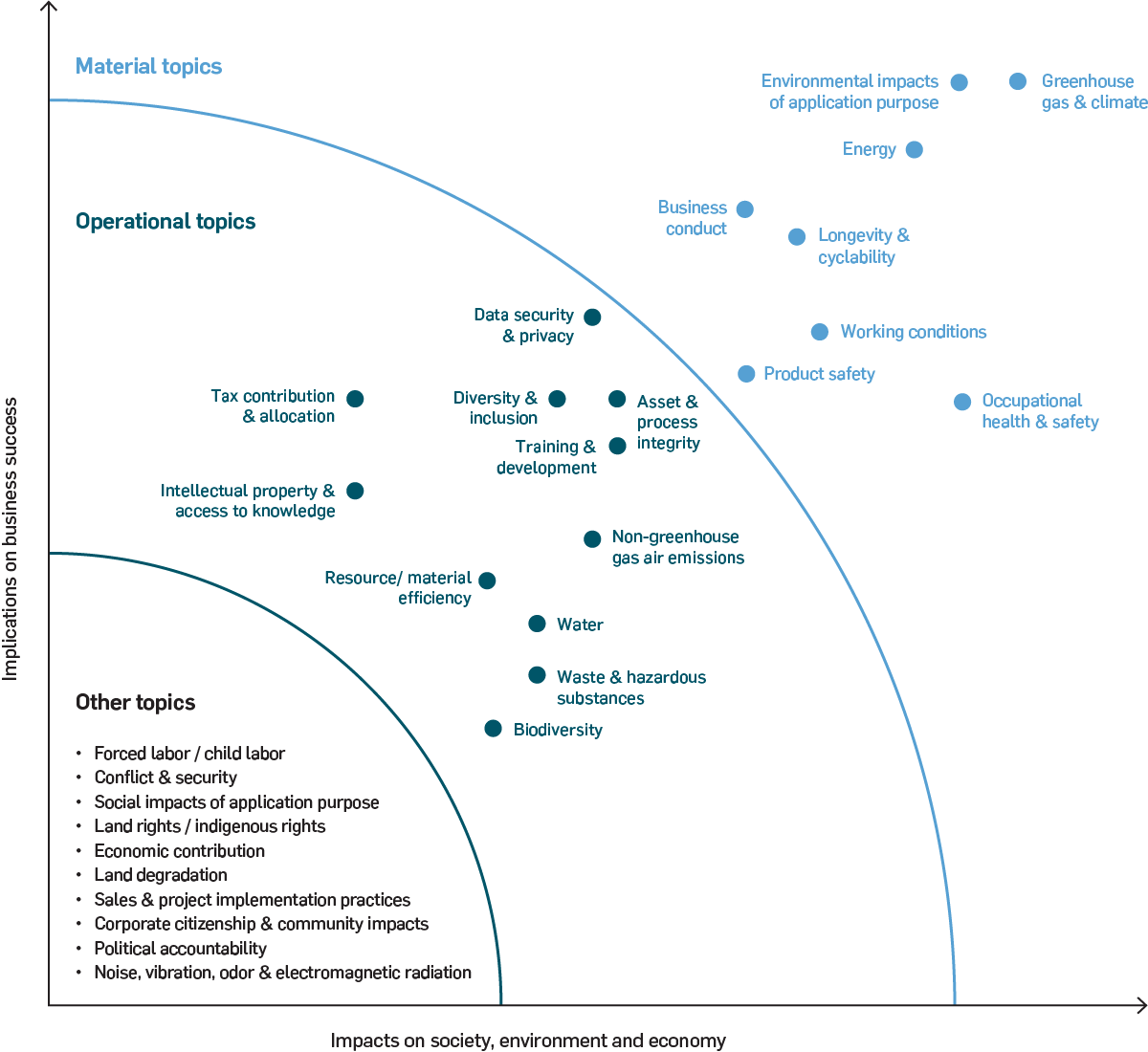
Our materiality matrix assessment
Material topics
Are included in our strategic approach to sustainability and are subject to extended reporting requirements for our Sustainability Report.
Operational topics
Have an increased relevance in our business activities and are continuously integrated into our operations; communication takes place according to needs and opportunities.
Other topics
May have increased relevance in a specific context but not on a Group level; management and communication take place according to needs and opportunities.
Our employees are the key to our success
Together we are successful and create sustainable value. We are engaged in the advancement of all employees and a diverse workforce. They are a vital factor in the implementation of our sustainability ambitions.
We appreciate our employees’ expertise and promote knowledge sharing. Individual training and development are part of the annual appraisal and performance review process and are financially supported by the company. To ensure the ongoing development of technological expertise and personal as well as managerial skills within the company, employees around the world participate in internal technical, product, and leadership training modules, which are conducted across the Group throughout the year with a range of programs. In the fiscal year 2025, we provided on average 13.1 h of internal training per FTE and reached 98.3% of our employees with our offering.
We promote and support new talent at all levels and are committed to the Swiss system of apprentice training. We currently have 68 apprentices, primarily at our production sites in Switzerland and India with additional apprentices in France and Germany. Burckhardt Compression is a founding member of the initiative launched under the auspices of the Swiss Federal Office for Professional Education and Technology and the Swiss-Indian Chamber of Commerce to establish an apprenticeship system in India based on the Swiss model. The company is also a corporate sponsor of the AZW Training Center in Winterthur, Switzerland, for vocational career pathways.
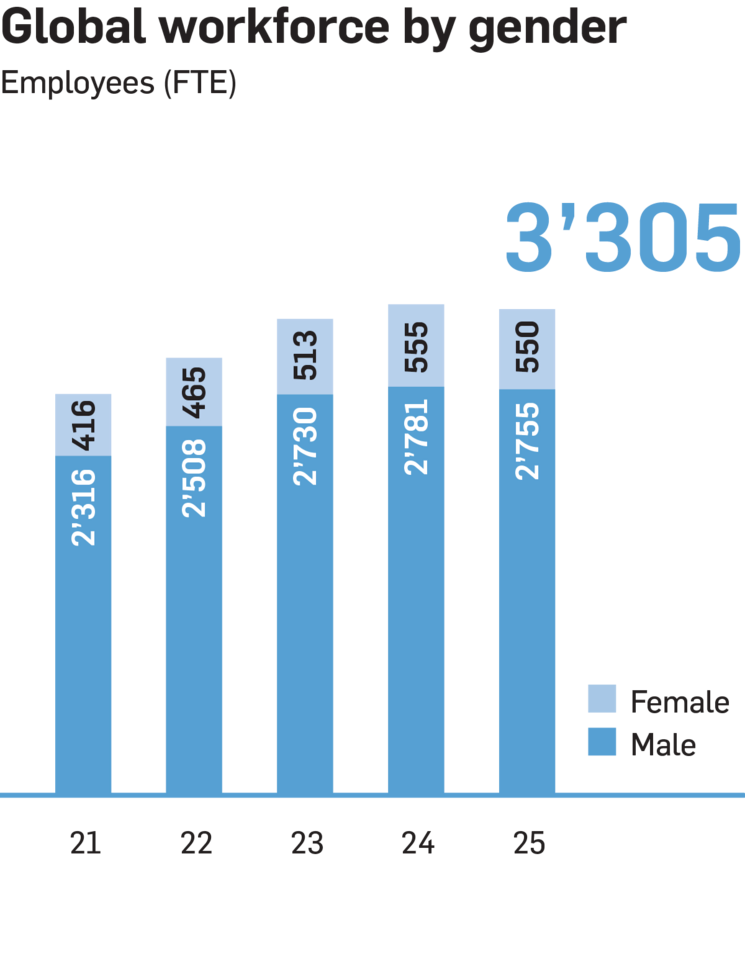
We believe that diverse teams, supported by an inclusive culture, contribute to stronger performance and long-term value creation. In fiscal year 2025, we advanced our diversity, equity and inclusion agenda. We established a structured roadmap aligned with the Board of Directors. It focuses on gender, age and intercultural collaboration, with an initial priority on gender
diversity. The roadmap is built around three levers of join (attract talent), stay (support retention), and thrive (enable development and progression) to strengthen our female talent foundation. First implementation steps were launched in the reporting period through targeted development measures aimed at strengthening capabilities, enabling career progression. Women made up 33.3% of the Board of Directors and 20% of Executive Management; women accounted for 16.6% of our global workforce (2024: 16:6%).
Downloads
- Sustainability report of 2025 EN pdf 1.21MB
More languages
No other languages available