
energy transition
Positioning for growth: Reciprocating compressors in the expanding CCUS market
October 28, 2026 8 min read


As Carbon Capture, Utilization, and Storage (CCUS) projects expand worldwide, our compressors are gaining traction in this emerging market, offering clear operational cost and performance advantages in special applications.
For years now, CCUS has been recognized as a key technology to achieve global net-zero ambitions. In its Sustainable Development Scenario, the International Energy Agency outlines a pathway how car bon dioxide (CO2) emissions from the global energy sector will reach net zero by 2070, with CCUS contributing nearly 15% of the emission reductions.
CCUS first gained prominence in the 1970s in the process of enhanced oil recovery (EOR). Today, it is expanding into sectors such as cement, steel and waste-to-energy. With global capture volumes projected to reach 10.4 gigatons annually by 20701, CCUS is forming an essential pillar of the energy transition and a growing market opportunity for reciprocating compressor technology.
The vital role of compressors in CCUS
Compressors are required at several stages throughout the entire CCUS process chain. After CO2 is captured directly from the air or from heavy emission sources, such as fossil-fuel power plants or steel mills, the captured CO2 is compressed. The compressor reduces the volume, International Energy Agency 36 of the gas, thus making it easier to transport by ship or pipeline.
When transported by pipeline, a compressor is crucial for keeping CO2 at high pressure to ensure efficient flow. When transported by ship, CO2 is usually liquefied. During CO2 liquefaction, the role of a compressor is critical, because the process requires CO2 to be brought to high pressure and controlled temperatures so that it can transition from gas to liquid.
At the end of its CCUS journey, CO2 is transported to the point of usage or storage. CO2 can be converted into products — it can be used as feedstock for producing chemicals or even synthetic and sustainable fuels. If it is directed towards storage, a compressor is essential in boosting CO2 to a higher pressure to inject into geological formations, like depleted oil and gas reservoirs.
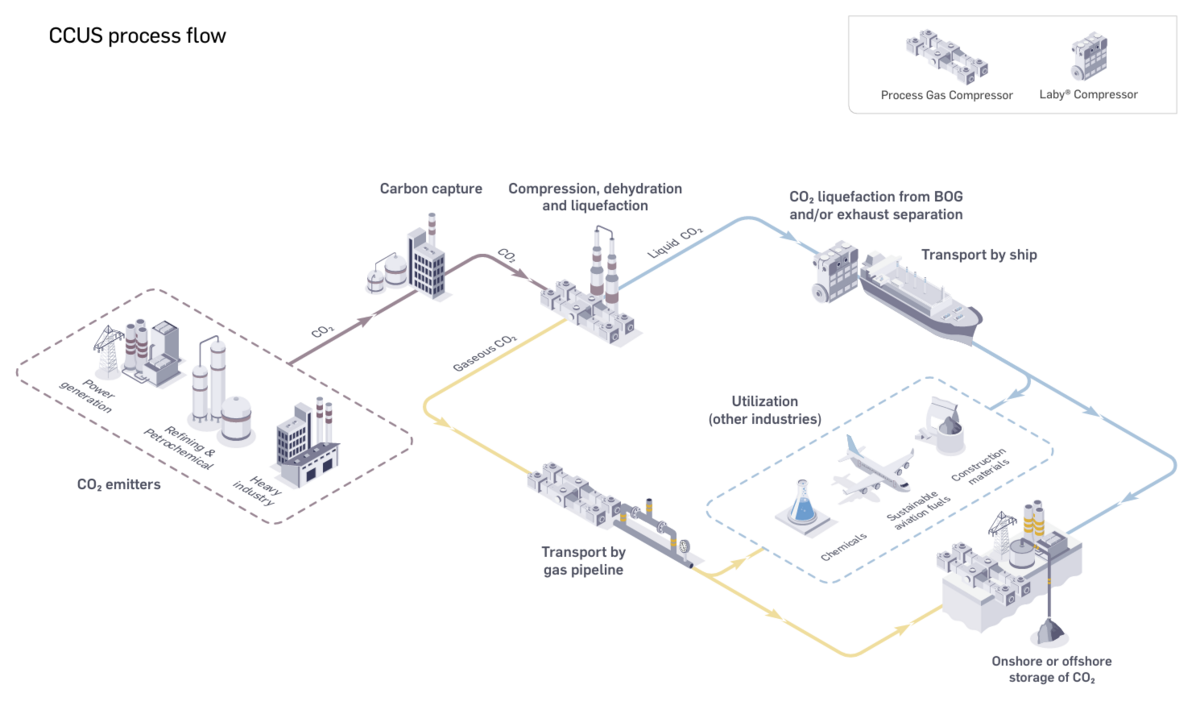
1. Carbon capture
CO₂ is captured from industrial sources or directly from the air and is then compressed.
2. CO2 compression
Compressors reduce the volume of captured CO2 for efficient transport.
3. Transport
Compressed CO2 is transported by pipeline or liquefied and transported by ship.
4A. Utilization
CO2 is used as feedstock for chemicals, fuels, and other industrial products.
4B. Storage
Compressors boost CO2 to a higher pressure for injection into geological storage sites.
Reassessing the dominance of centrifugal compressors
Because CCUS requires significant initial investment, early projects were concentrated in industries and sectors with very high CO2 emissions, where the high CO2 quantities justified the use of centrifugal compressors.
As governments worldwide introduce tax incentives and funding for CCUS initiatives, technology is becoming more accessible and appealing to industries facing emission penalties and net-zero commitments. Reciprocating compressors, the technology where Burckhardt Compression holds a leading position, can handle capacities of up to 2.5 MTPA (million tonnes per annum). They are ideally suited for CCUS projects emerging across sectors such as cement, biofuel and waste-to-energy, and can also be applied to direct air capture applications.
Reciprocating compressors provide higher operational flexibility, efficiency and lower operating costs
Beyond offering a different capacity range, our reciprocating compressors stand out for one key reason — their higher efficiency compared to centrifugal compressors.
Centrifugal compressors are engineered to deliver peak performance when operating conditions, such as temperature and gas flow, closely match their defined “design point”. Because of this narrow operating window, even small deviations re quire operational adjustments or bypass systems to maintain process stability. These corrective measures lower efficiency and drive up operating costs. On the other hand, reciprocating com pressors offer high efficiency even under changing process conditions. Capacity control can be achieved through speed variation and advanced volume control methods, such as clearance pocket adjustment or valve unloading, which do not significantly impact system efficiency.
The cost competitiveness of centrifu gal compressors is negatively impacted when operating conditions, in particular flow rate, vary. In contrast, reciprocating compressors can adapt to fluctuating conditions with minimal impact on efficiency. For CO2 compression in CCUS applications — where high pressures, variable conditions, and reliability are essential, reciprocating compressors offer clear advantages. They deliver superior energy efficiency, operational flexibility, and lower lifecycle costs, making them the preferred choice for most high-pressure CO2 processes such as liquefaction, pipeline boosting, geological storage, including EOR.
Reciprocating vs. centrifugal compressors for CCUS: Which is the better choice?
| When are reciprocating compressors preferred over centrifugal compressors in CCUS applications? | Reciprocating compressors are preferred for high-pressure CCUS applications with variable operating conditions. They are suitable for projects up to 2.5 MTPA, including direct air capture, CO2 liquefaction, pipeline transport, and geological storage. |
|---|---|
| Why are reciprocating compressors more efficient than centrifugal compressors? | Reciprocating compressors maintain high efficiency across a wide range of operating conditions, including fluctuating temperatures and CO2 flow rates. In contrast, centrifugal compressors achieve peak efficiency only near their design point. |
| Why do reciprocating compressors provide lower operating costs than centrifugal compressors in CCUS applications? | Reciprocating compressors provide lower operating costs because they maintain high efficiency under varying CO2 flow rates and operating conditions, minimizing energy consumption and the need for efficiency-reducing adjustments. |
Government incentives to accelerate CCUS projects
Governments around the world are accelerating CCUS deployment by introducing stronger investment incentives, climate targets, and carbon trading schemes.
Many major countries around the world, such as the UK, Japan, India, Australia and the EU countries recognize car bon storage within their emission trading schemes or carbon-credit systems. For example, the EU’s European Innovation Fund regularly provides grants to CCUS projects, supporting up to 60% of a project’s total cost. Together, these measures are building significant global momentum for CCUS and enabling faster adoption across multiple sectors.
From 2017 onward, the number of CCUS projects under development grew at an annual average rate of 35%. Worldwide, there are currently 73 CCUS projects actively under construction and more than 900 additional CCUS projects in the pipeline2. As this momentum accelerates, the need for efficient and reliable CO2 compression technology has never been greater.
Burckhardt Compression is well positioned to support this growth. With over 70 years of experience and around 500 compressors globally in CO2 service, we have vast expertise in CO2 compression. Our product portfolio places us as the go to company in the industry: the process gas compressor produced in Switzerland, India and China, and the fully balanced high-speed compressor exclusively produced in China. With production facilities in different parts of the world and a globally responsive service network, we can reliably support customers and respond quickly to the growing demand for CCUS projects.
1 Source: Sustainable Development Scenario, International Energy Agency
2 Source: Global CCUS Build-out Tracker, Renewable Vision
Key takeaways
- CO2 compression is essential for CCUS, enabling efficient transport and geological storage after carbon capture.
- Reciprocating compressors are particularly well suited for medium-sized CCUS projects, including applications in cement, biofuels, waste-to-energy, and direct air capture.
- Compared to centrifugal compressors, reciprocating compressors deliver higher efficiency, greater operational flexibility, and lower operating costs under variable conditions.
- Growing investment in CCUS is driving demand for high-pressure CO2 compression technologies, creating new opportunities for reciprocating compressors.
Downloads
- Efficient CO compression solutions for carbon capture, utilization and storage EN pdf 695KB
More languages
No other languages available
Contact your CCUS expert
Looking for a CO2 compression solution for your CCUS project? Our experts are here to help.
More insights
Transforming compressor maintenance through AI and digital innovation
Digital services are reshaping compressor care with real-time data insights extending maintenance intervals. This reduces production interruptions, helping our customers to save costs.
October 21, 2026 6 min read


How our compressors support the decarbonization of aviation
Sustainable aviation fuel is moving from ambition to implementation.
September 23, 2026 8 min read
