
Transport and storage
The rise of LNG terminals: Optimizing costs and boosting sustainability with our Laby compressor system
November 4, 2026 | 8 min read
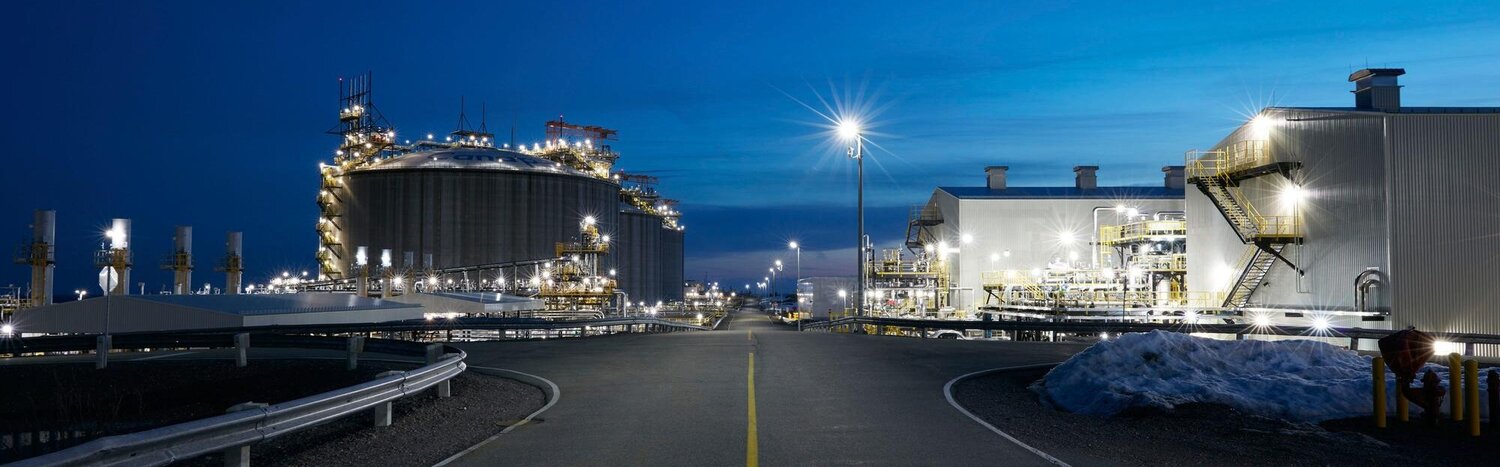


Liquefied natural gas (LNG) is well positioned as a transitional fuel, thanks to its significantly lower CO2 footprint compared to coal and oil. Today, geopolitical disruptions prompt governments to build LNG terminals to diversify their energy resources. Engineered for reliability and to meet demanding operating conditions, our Laby® compressor technology proves essential for safeguarding critical LNG supply chains worldwide.
With the rapid expansion of the global LNG market, demand will rise not only for overseas transport but also for LNG terminals to receive, store, and regasify LNG. From loading LNG on a carrier ship to compressing it through a pipeline, our compressors operate at crucial process points of LNG terminals.
In the past, LNG terminals were solely designed to send gas through pipelines to consumers. Today, with fluctuating demand, supply, and prices, LNG terminals must operate as flexible, high-performance distribution hubs – constantly prepared to receive, store, and dispatch varying volumes of LNG. The LNG distribution network encompasses multiple stages from liquefaction to regasification. Throughout this journey, compressors play a vital role by handling “boil-off gas”.
Handling boil-off gas with our Laby compressor system
When LNG is stored at a terminal, it is kept at atmospheric pressure and cryogenic temperatures – temperatures below -160˚C. This is much lower than the surface temperature of the storage tank, causing the gas to continuously evaporate. This occurrence is called “boil-off gas” (BOG).
If BOG is not managed, it accumulates and must be vented or flared – leading to safety risks, financial loss and significant environmental impact due to emissions of 24 methane, the main component of LNG. By compressing BOG, the Laby compressor system enables LNG terminal operators to significantly reduce greenhouse gas emissions and achieve substantial cost savings by reinjecting evaporated gas into the distribution stream. This approach en sures efficient handling of BOG while sup porting sustainability goals.
Managing BOG is essential for both economic efficiency and environmental performance in the LNG supply chain. Two primary strategies are commonly employed: reliquefication and utilization as fuel.
Reliquefication recovers the gas by capturing, compressing, and condensing it back into liquid form before returning it to the main storage tank. Alternatively, BOG can be utilized as a fuel source for operational needs. At LNG terminals, BOG is typically compressed and used for on site operations, where the Laby Compressor plays a key role, or injected directly into the local gas pipeline network using an MSO compressor system like the Laby®-GI or the AP618 compressor.
Both methods aim to minimize losses, reduce emissions, and optimize overall LNG handling.
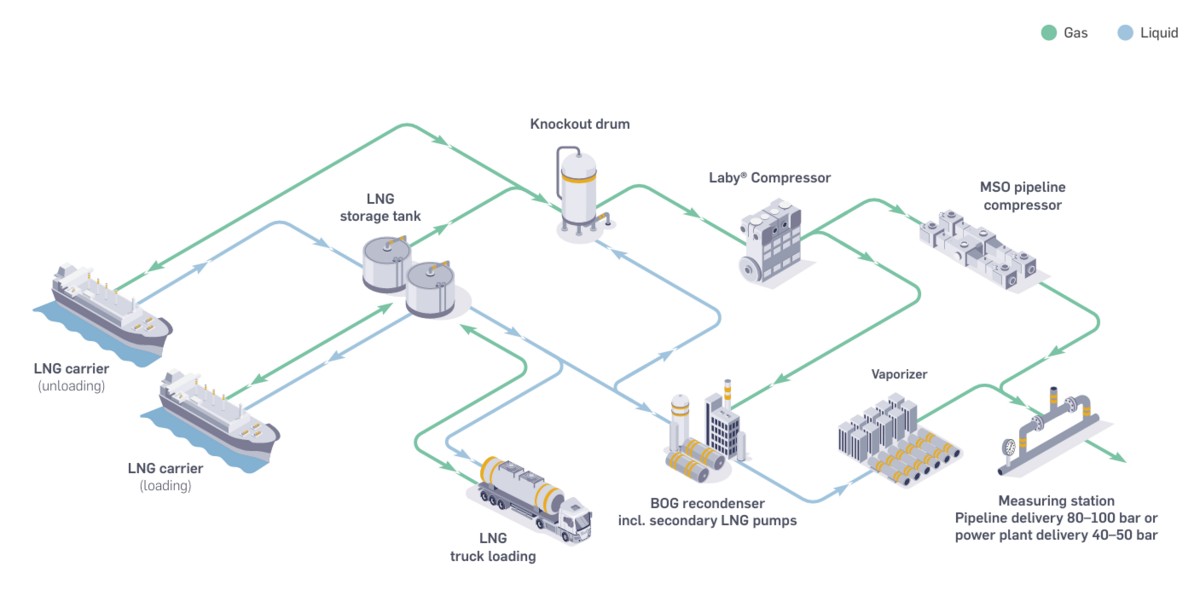
Typical boil-off gas handling process
- LNG is stored at very low temperatures in insulated tanks.
- A small portion of the LNG evaporates, creating boil-off gas (BOG).
- BOG is collected and routed to the compressor system.
- The gas is compressed using a Laby Compressor.
- Compressed BOG is returned to storage or injected into the gas pipeline network.
- Product losses and emissions are reduced.
Laby Compressors have unique advantages for LNG terminals
The Laby Compressor is purpose-built and carries a unique set of specifications to suit demanding operating conditions at LNG terminals.
As BOG volumes fluctuate, handling it often requires frequent start-stop cycles, which place significant stress on the com pressor’s suction and discharge valves. The valves of our Laby Compressors are designed and manufactured in-house to precisely match operating conditions – extremely low temperatures and fluctuating flows. This ensures high reliability and compressor running time, reducing maintenance costs.
Even the slightest trace of oil contamination can compromise gas quality. The Laby Compressor overcomes this challenge with a unique labyrinth piston design and specialized low-temperature materials that enable completely oil-free and contactless compression. This design eliminates the need for lubrication, reduces wear, and ensures reliable operation across a wide temperature range – from cryogenic suction at -160°C up to discharge temperatures as high as +200°C. By removing the need for pre-heating and conditioning BOG, the Laby Compressor technology delivers flexibility and efficiency, making it the ideal solution for LNG terminals where purity and reliability are critical.
Reducing costs and increasing operational sustainability
Laby Compressors play a critical role in LNG terminals by efficiently and reliably handling BOG. Their unique gas-tight design minimizes leakages, offers long intervals between overhauls, and delivers a proven track record for availability and reliability. Combined with low operating and maintenance costs over the compressor system’s lifetime, these features make Laby compressor systems a preferred choice for LNG terminals. Additionally, Laby compressor systems can handle cryogenic temperatures with ease, ensuring flexibility and maximum uptime in demanding LNG applications.
LNG boil-off gas (BOG) compression FAQs
| Why is BOG compression demanding? | BOG handling combines fluctuating gas flows, frequent start-stop cycles, cryogenic temperatures down to -160°C, and strict gas purity requirements. These demanding conditions require highly reliable compressor technology. |
|---|---|
| Why are oil-free labyrinth piston compressors well suited for BOG applications? | Their contactless compression principle prevents oil contamination while reliably handling cryogenic temperatures and fluctuating operating conditions. The Laby Compressor enables direct compression of boil-off gas (BOG) without pre-heating or gas conditioning. |
| Why does the Laby Compressor offer lower OPEX than other compressor technologies? | The Laby Compressor's oil-free and contactless design minimizes wear, while its gas-tight construction and robust valve technology ensure high reliability and long intervals between overhauls. This reduces maintenance requirements, maximizes availability, and lowers lifecycle costs. |
Further LNG terminal market growth expected in the coming years
Valued at USD 9.0 bn in 2025, the LNG terminal market is expected to reach USD 33.1 bn in 20351. The top two countries leading the rise in LNG demand are China and India as they expand their LNG demand for industrial and manufacturing needs, as well as scaling down on coal to transition to cleaner energy. Countries fol lowing are Germany and the UK, where apart from energy-source diversification, the reason lies in enhancing their energy security.
As countries phase down on coal usage and shift to gas as a transitional fuel, LNG terminals have become critical strategic assets for energy security. Geopolitical disruptions are prompting governments and private operators to invest in building resilient energy infrastructure. As LNG demand grows, the need for robust compression solutions like the Laby compressor system will only accelerate.
1 Source: LNG terminal market size and share forecast outlook 2025 to 2035, Future Market Insights
Customer testimonial
We’ve been operating two Burckhardt Compression labyrinth-piston compressors in BOG duty since 2009 with total combined running hours of around 120’000 over a 16-year period. Whilst we have seen individual compressor failures, typically system reliability is 100%, with availability of 99.97% in 2025. Using labyrinth-piston type compressors as opposed to ringed pistons reduces friction, wear, contamination risk, and therefore increases reliability and reduces operating expenses. It also means that oil separation devices are not required to clean the process gas post-compression.
Dragon LNG Limited, Wales, United Kingdom
Key takeaways
- Managing boil-off gas (BOG) is essential for reducing greenhouse gas emissions and recovering evaporated gas that would otherwise be vented or flared.
- The Laby Compressor helps LNG terminal operators recover and reuse evaporated gas, reducing emissions while improving operational efficiency and supporting sustainability goals.
- The Laby Compressor's oil-free labyrinth piston design ensures gas purity and enables direct compression of cryogenic BOG without pre-heating or gas conditioning.
- High reliability, long intervals between overhauls, and low operating and maintenance costs make Laby compressor systems a preferred choice for LNG terminals.
Downloads
- Compressor solutions for LNG onshore terminal applications EN pdf 9.26MB
More languages
No other languages available
Contact your LNG compression expert
Are you planning an LNG terminal project? Talk to our experts.
More insights

How our compressors support the decarbonization of aviation
Sustainable aviation fuel is moving from ambition to implementation.
September 23, 2026 8 min read

Enabling Europe’s Hydrogen Backbone: compression technology for large-scale storage
How we are supporting Europe's energy transition.
October 7, 2026 7 min read
